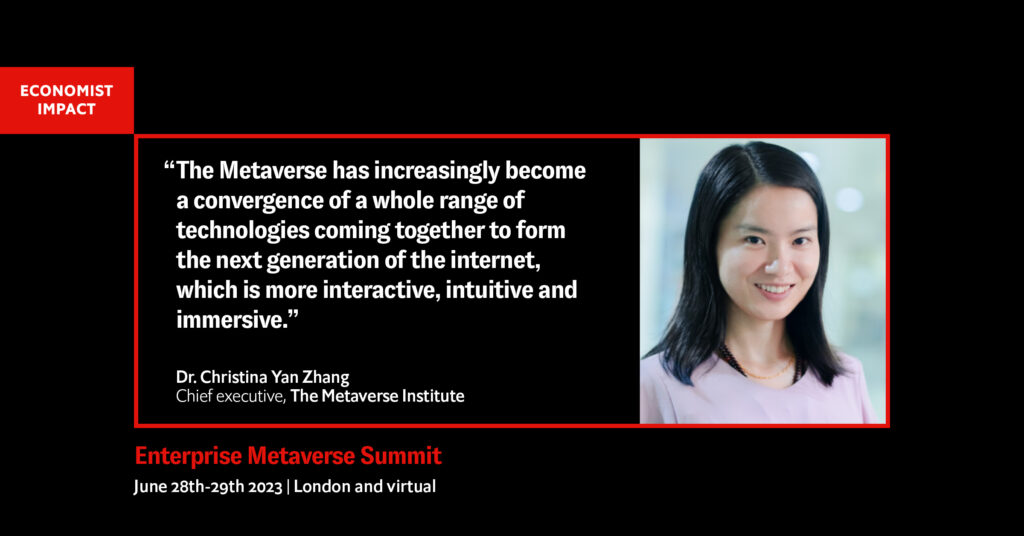
Hosted at the Hilton London Bankside on 28 June, the widely-read publication will kick off the two-day event and host attendees from the global tech community.
Speakers, thought leaders, panellists, companies, and organisations will attend the Summit to explore the industrial metaverse: a key component of Industry 4.0 that analysts predict will reach nearly $48 billion USD in value, according to research from McKinsey.
Critical points of discussion will include industrial use cases, digital twins, immersive hardware and software, and theoretical and ethical considerations for developing the industrial metaverse. Many of the technologies involved will lead to greater workplace safety, increased training efficacy, and facilitated collaborative efforts.
Across the virtual, augmented, mixed, and extended reality (VR/AR/MR/XR) sectors, the Enterprise Metaverse Summit will feature some of the world’s top frontrunners for the industrial metaverse and related technologies.
Additional technologies will include 5G, the blockchain, cryptocurrencies, artificial intelligence (AI), and more.
Overall, the event will host more than 100 global speakers, over 60 main and breakaway sessions, and an attendee list surpassing 300 people.
Sponsors for the stellar event also include Meta Platforms, PricewaterhouseCoopers (PwC), VRARA London, Siemens, HTC VIVE, Deloitte, Aveva, and BGC X.
Enterprise Metaverse Summit Speaker Lineup
The event will host a stellar roster of speakers, organisations, academics, and companies. Some of the top speakers attending the Summit are:
Eva Maydell, Member of the European Parliament
Sudeep Shetty, Global Chief Information and Transformation Officer, BRITVIC PLC
Dr Lisa Cameron MP, Chair, Crypto and Digital Assets, All Party Parliamentary Group, UK Parliament
Holly Landry, Chief data officer, Maersk
Lisa Smith, Partner, Inclusion Lead, Unlimited Reality, Deloitte
Gerhard Kress, Vice-President, Xcelerator Portfolio and Digital Business, Siemens
Christine Trodella, Vice-President, Meta Reality Labs, Meta
Nathan Naidoo, Director of Public Policy, Meta
Emmanuelle Rivet, Vice-Chair, US TMT & global technology leader, PwC
John Dabill, John Dabill, Director, EMEA, HTC VIVE
Jay Koganti, Vice-President, Supply Chain COE, The Estée Lauder Companies
Joan O’Hara, Senior Vice-President, Public Policy, XR Association
Sebastian Pedro Bea, President, Coinbase Asset Management
Dr Muhsinah Morris, Metaversity Director and Assistant Professor, Morehouse College and Chief Executive, Metaverse United
Dr Christina Yan Zhang, Chief Executive, The Metaverse Institute
The Finnish city used Tampere Smart City Expo to showcase how it aims to combine the digital and physical worlds to enhance the lives of city dwellers.
The Finnish city of Tampere is inviting companies to test their smart city solutions as it takes its first steps to becoming “a human-centric metaverse city”.
It used the recent Tampere Smart City Expo & Conference to showcase how it aims to combine the digital and physical worlds and create a vibrant digital environment that enhances the lives of city dwellers.
The metaverse and digital twins
The international Tampere Smart City Expo & Conference convened experts from around the world to share ideas in areas such as Web3 technology, sustainability, artificial intelligence and mobility.
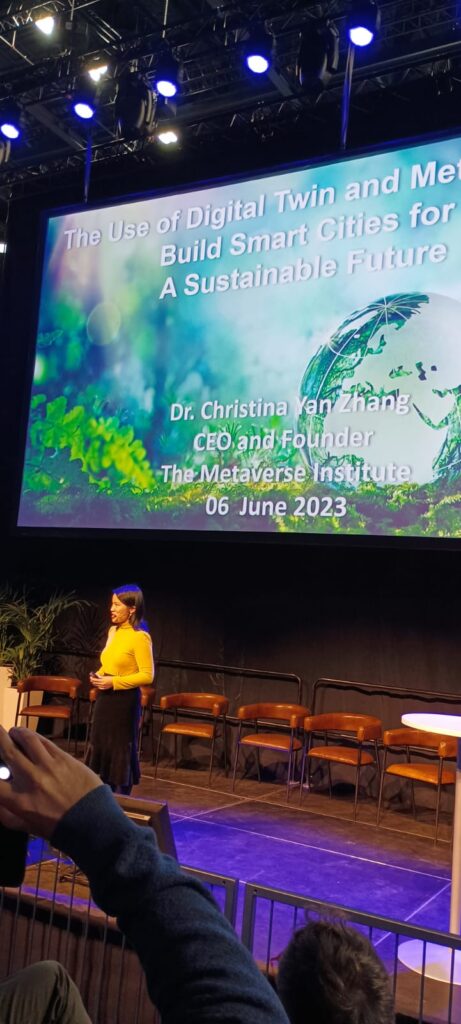
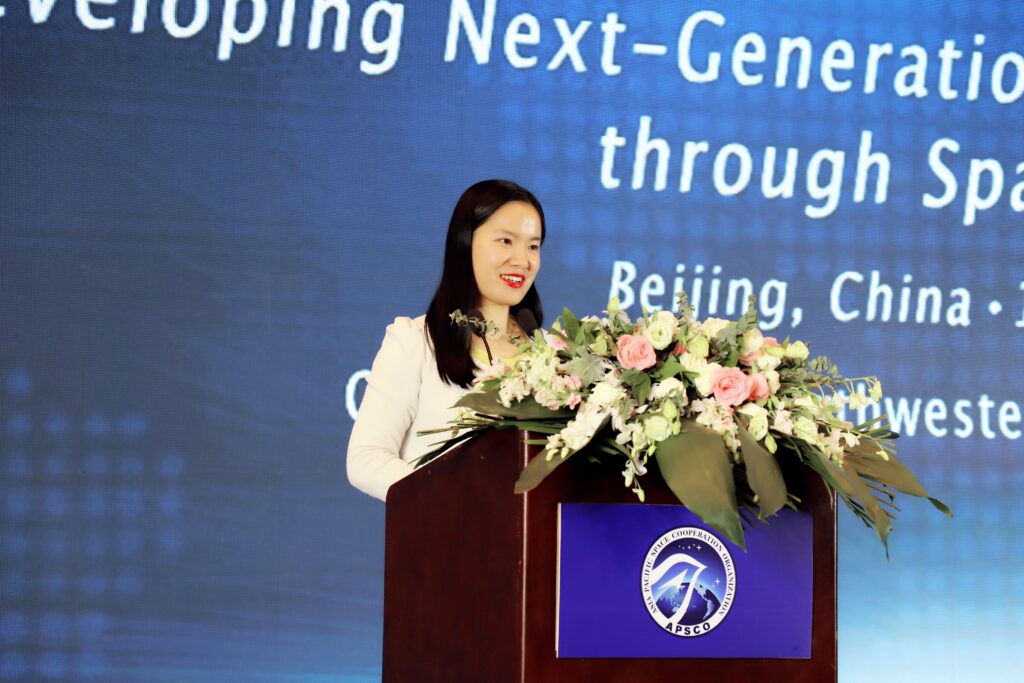
Keynote speakers included Christina Yan Zhang, CEO of the Metaverse Institute, whose speech focused on the use of digital twin and metaverse technology to build smart and sustainable cities. The event was opened by Kalervo Kummola, mayor of Tampere.
“Through intelligent solutions, our goal is to enhance the wellbeing of citizens, provide a positive urban experience, and create favourable conditions for people’s everyday lives”
The development of Tampere’s metaverse is a result of collaborations with industry-leading companies. Through partnerships with VTT Technical Research centre of Finland and global technology giants such as Microsoft and Nokia, it aims to harness the potential of the metaverse in areas such as urban planning and citizen wellbeing.
“We invite companies to test their solutions in Tampere. The city acts as a testing platform and an open partner for businesses and research,” said Teppo Rantanen, the executive director of growth, innovation and competitiveness at the City of Tampere.
“Through intelligent solutions, our goal is to enhance the wellbeing of citizens, provide a positive urban experience, and create favourable conditions for people’s everyday lives.”
The city said it is committed to sustainability, responsible data utilisation, and ethical metaverse practices. With a focus on human-centricity and stated that technological advancements must serve as catalysts for positive urban experiences.
Tampere’s metaverse-vision is driven by the belief that collaboration between cities, businesses, and ecosystem partners is essential to unlock the full potential of the technology. By embracing this collaborative approach, Tampere hopes to inspire and invite other cities and organisations to join forces in shaping the future of urban, human-centric living.
Tampere Smart City Expo & Conference will take place again next year 11-12 June.
Increasingly, more and more cities are piloting different technologies within the metaverse ecosystem to provide more inclusive cities development to ensure the needs of diverse community groups are fully represented and proactively engaged at all levels. How could cities governments use metaverse and digital twins to develop smart cities of a sustainable future? This is what I will be speaking on 6th June 2023 at the Tampere Smart City Expo & Conference.
On 20 Mar 2023, The Intergovernmental Panel on Climate Change (IPCC), made up of the world’s leading climate scientists, delivered a “final warning” on the climate crisis: the world still has a chance of limiting global temperature rises to 1.5C above pre-industrial levels, the threshold beyond which our damage to the climate will rapidly become irreversible.
In response, the UN secretary general, António Guterres, said: “This report is a clarion call to massively fast-track climate efforts by every country and every sector and on every timeframe. Our world needs climate action on all fronts: everything, everywhere, all at once.”
I cannot agree with the statement more. It is a survival issue- now or never! Unfortunately, according to the latest report from UN, at current pace we won’t achieve the Sustainable Development Goals and the latest Climate COP confirmed we won’t reach the Paris Climate Agreement goals either. We need to continue doing more and better of what works so far and really provide the funding and support in place to accelerate this. Meanwhile, maybe we also need to be more imaginative to explore what new methods, new ideas, new techniques and how they can be used to address the survival and wellbeing issues of all humanity.
Cities has played an important part in addressing climate changes over the years. Over half(55%) the world currently resides in major urban areas. By 2050 the UN estimates that number will grow to 80%. With proximity and access to networks, cities have been engines of innovation for centuries, providing a clear path from poverty to prosperity for many. Most cities in the world have put sustainability at the heart of all policies implementation.
The Metaverse
The term ‘metaverse’ is nothing new. Author Neal Stephenson coined the word in his 1992 science-fiction novel ‘Snow Crash’, which envisions a virtual reality-based successor to the internet. In the novel, people use digital avatars of themselves to explore the online world.
The 2003 virtual world Second Life is often described as the first metaverse platform. Second Life allows people to create an avatar for themselves and have a parallel life in an online virtual world. Developed and owned by the San Francisco-based firm Linden Lab and launched on June 23, 2003, it saw rapid growth for some years and in 2013 it had approximately one million regular users. It is still going strong as of 2022, with around 900,000 active users.
I was lucky to be one of the early adopters of the metaverse, in 2006. I saw it as the next generation of the internet, and both my master’s degree and PhD were focused on using the metaverse to help education institutions develop their international strategy, and on how architects, engineers and the construction industry can use digital twins in the virtual world for simulations, aimed at improving real world AEC projects.
The metaverse we talk about today is the second attempt at mass adoption. It started with a successful IPO of Roblox in March 2021, which achieved a market value of $38bn. The excitement about the metaverse really ramped up after Facebook changed its name to Meta in October that year.
Now, the metaverse has become a convergence of a whole range of cutting-edge technologies, which together will form the next generation of the internet. These include better and faster IT infrastructure, such as 5G and 6G mobile networks; new user interfaces such as XR, wearables, haptics, and voice/gesture recognition; and new computing technologies such as spatial, edge and quantum computing. There are also new information-organising tools such as AI and machine learning; digital-finance technologies such as blockchain, NFTs, and cryptocurrency; and new forms of social interaction online, such as e-sports, virtual events and gaming. Many of these developments are interrelated or even interdependent, but it is still uncertain what shape the emerging ecosystem will take. Nevertheless, it seems inevitable that many of these elements will combine to make the internet more immersive, interactive and intuitive.
Digital Twins:
The idea of a “digital twin” was born at NASA in the 1960s as a “living model” of the Apollo mission. In response to Apollo 13’s oxygen tank explosion and subsequent damage to the main engine, NASA employed multiple simulators to evaluate the failure and extended a physical model of the vehicle to include digital components. This “digital twin” was the first of its kind, allowing for a continuous ingestion of data to model the events leading to up to the accident for forensic analysis and exploration of next steps.
A digital twin is a dynamic virtual copy of a physical asset, process, system or environment that looks like and behaves identically to its real-world counterpart. A digital twin ingests data and replicates processes so you can predict possible performance outcomes and issues that the real-world product might undergo.
Digital twin is one of the key metaverse technologies that can also play a key role as a sustainability solution, by helping to model, monitor and predict changes to the Earth’s climate system on a city, country and global levels. The European Commission has invested 150 million Euro to create digital twins of the Earth named “Destination Earth”, which will start by simulating extreme events and climate change adaptation. The long-term goal is to integrate simulations of the oceans and biodiversity by 2030. Similarly, Nvidia’s “Earth-2” is another digital twin able to predict, monitor and mitigate climate change using AI and machine-learning.
Using Metaverses for People centred Smart Cities Development
There are two types of application. One is to use the metaverse to develop a brand-new city from scratch, such as the $500 billion Neom City in Saudi Arabia. Most of them are focusing on using the new technologies to improve efficiency of existing cities with different focuses. For example, traffic control is an important area explored by many cities such as New York, Shanghai, Tokyo, Wellington. Some cities are focusing on using the gamified feature of the metaverse to attract more consumers for the local shops such as Santa Monica. Seoul has been exploring the use of the metaverse to improve its public services while Dubai and Abu Dhabi are focusing on positioning themselves as the global tech hub for metaverse technology adoption.
What interest me most is how to the use the metaverse to empower the citizens to play more active roles in key decision makings of the future of their cities. The decentralized nature of the metaverse has the potential to give power back to the end-users and employees, and allow them to play a more proactive role in business and society.
I gave a keynote speech in November 2022 at the Smart City Expo World Congress in Barcelona looking at how to use digital twin in the metaverse to support mayors worldwide to develop smart cities. The metaverse has the potential to provide millions of citizens with an “immersive, interactive and intuitive user interface” which will allow urban planning to become more “bottom-up”. 3D visualisation could become a powerful tool for the general public to better understand how the city’s development would impact on their daily life. It could also incorporate information on CO2 reductions, empowering millions to play a more active role in fighting climate change.
This is what we call people centred metaverse strategy for smart cities of a sustainable future. Why not join us and let us use various technologies in the metaverse environment to make our cities inclusive, equitable and sustainable.
By leveraging the metaverse and digital twin, we can design and build sustainable smart cities. We all need to act proactively and quickly to stop global warming,” says Christina Yan Zhang.
The metaverse has become a unifying and unifying force for many new technologies, says Dr. Christina Yan Zhang, CEO and founder of the Metaverse Institute.
The metaverse has been described as a next-generation internet. It is an entity consisting of virtual spaces that can be used to create more realistic experiences online.
Christina Yan Zhang, CEO and founder of the Metaverse Institute
Yan Zhang, who has worked with the metaverse for almost two decades, is particularly interested in how metaverse technologies can be better utilised in sustainable and environmentally friendly urban planning.
“In the future, the majority of the population will live in cities, so with environmentally conscious, resident-oriented urban planning, we can have a huge impact on building sustainable living environments,” says Yan Zhang.
“If we don’t act now, we’re in trouble. Global warming must be halted, and in addition to industry, cities play a key role in this work.”
Digital simulation revolutionises construction
According to Christina Yan Zhang, the metaverse and the technologies connected to it offer new opportunities for solving the global climate problem. Especially with the help of digital twins, modelling is already producing results, and its utilisation is only in its early stages.
“Any kind of activity can be simulated in the metaverse with the help of a digital twin. By digitally modelling the physical world, we can plan evacuation situations in advance or assess the effects of natural forces on buildings before the construction phase,” says Yan Zhang.
“If we don’t act now, we’re in trouble. Global warming must be stopped.”
“New York and Tokyo have used metaverse platforms to plan traffic flows and prevent congestion. Dubai and Abu Dhabi are using the metaverse to create new jobs,” says Yan Zhang enthusiastically.
“There are plenty of examples of digital simulation around the world. By leveraging metaverse technologies and the digital twin, designing smart cities has never been easier.”
Sustainable lifestyle is everyone’s business
The key to building smart cities is action to combat climate change.
“With the digital twin, we can, for example, model residents’ carbon emissions and reduce them. I believe that a sustainable lifestyle is a matter for every citizen. However, structures must enable climate-friendly activities,” says Christina Yan Zhang.
“We all need to be active in order to reach the UN Sustainable Development Goals in time. Extreme natural phenomena have increased alarmingly,” Yan Zhang points out.
“With new technologies, we have potential solutions at our fingertips, not forgetting hydrogen and fusion power. I hope that city leaders and planners will take swift action to promote sustainable urban development.”
Christina Yan Zhang will perform as a keynote speaker on the main stage of Tampere Smart City Expo &; Conference on 6.6.2023. Welcome to learn about the cities of the future!
Tampere Trade Fairs
Finland’s second largest exhibition and event company covers the year’s most uplifting encounters, current issues and burning services at the top of professional fields, Tampere Exhibition and Sports Centre.
The international Tampere Smart City Expo &; Conference for smart city development and ICT will be held on 6–7 June at Nokia Arena. The theme of the event is Beyond the Abstract, which dives into the urban metaverse, with Digitally Smart, Urban Intelligence and Responsible ColLAB as its perspectives. International encounters in the field and networking of top experts play a significant role in Tampere Smart City Expo & Conference.
In addition to a comprehensive trade fair calendar, Tampere Fair brings joy and experiences to consumers’ lives throughout the year. Check out the event calendar.
Dr. Christina Yan Zhang is the CEO of The Metaverse Institute, which is made up of a group of pioneers in the Metaverse, AI, digital twin, Smart Cities assisting organizations using related technology to improve the real world. She was also the speaker at this year’s Tomorrow Conference in Belgrade, where she gave a presentation titled “Generative AI for the Metaverse – Hype, Hope or Hell?”
Christina is a pioneer in the metaverse. She started her master’s research on the topic in 2006 using metaverse to develop international strategies for universities. In 2012, she completed a PhD in using digital twin services in the metaverse to simulate projects in the AEC industry.
“Metaverse can also be used for our wellbeing. For example, let’s say that you want to start eating healthier. Based on what food you eat, how many calories you’re taking in, how much you exercise and so on, you could project exactly what you will look like in ten years. Wouldn’t that be quite a motivation?”, she asked enthusiastically.
As one of the greatest contemporary examples, she mentioned the planned smart city called Neom in Saudi Arabia.
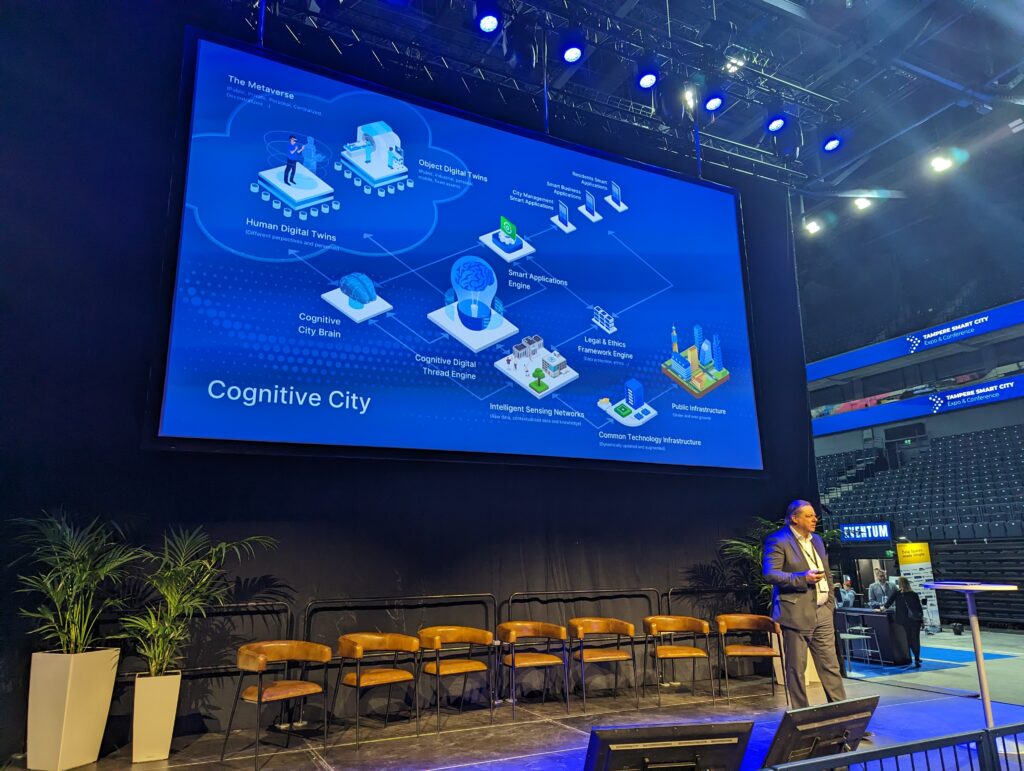
“If we talk about smart cities development, look at Saudi Arabia. They are building Neom, the city of the future. It’s the world’s first cognitive city, which simulates the whole city infrastructure within the metaverse environment before they put it in the real world. That’s quite an interesting way to explore – to give citizens the opportunity to see how their city will look before they implement it”, she explained.
However, she reminded that many people today still don’t have access to the internet and pointed out that we as a humanity need to be careful not to create an even wider gap between those who do have access and those who don’t.
“That’s the mistake we made in the past and we must be careful not to repeat it. On the other hand, Metaverse has also created more opportunities for people who weren’t as equal because it made the world more accessible to them and gave them opportunities for interaction”, she told us.
Finally, she made a point that we’re only familiar with only 5% of the internet which is accessible through standard search engines. Therefore, when we’re talking about cybersecurity, we shouldn’t only think about those 5% that we’re familiar with.
Irina Bokova, from the International Science Council and a former director general of UNESCO, speaks to Arab News in Riyadh. (Abdulrahman bin Shalhoub)
Younger generations can drive collaboration, former UNESCO chief says
New technology provides medium for greater youth engagement, Metaverse Institute CEO says
RIYADH: Engaging young people in the business of finding solutions to global challenges like climate change is one of the key themes of the inaugural Future of Education, Science and Culture International Organizations Forum, which opened in Riyadh on Wednesday.
The topic of youth engagement is at the forefront of several panels at the two-day conference, including sessions on “The Future is Digital — Building Capacity in Organizations,” “Youth and Inclusion in the Education, Science, Technology and Culture Sectors” and “Greening the Agenda — Future of Education.”
“The global and regional organizations that have staged this forum have the same mandate across several continents,” Irina Bokova, from the International Science Council and a former director general of UNESCO, told Arab News.
“We have different challenges in achieving the same sustainable development goal, which is universal, not just for the Global South, but for everybody. While listening to the debate this morning, I am even more convinced that nowadays, we should go beyond our discussions about cooperation and collaboration. We need to find synergies.”
Bokova said that young people around the world were key to building such synergies and must be educated in the art of collaboration so as to bring people closer together, especially in scientific fields.
“I sincerely hope that concrete partnerships or ideas will emerge from this conference,” she said.
“Placing an emphasis on science and research is something that I want to happen, particularly in the Arab world because it can provide great access to education for young people as well as others,” Bokova added.
“Technology is also crucial and we know that it is very unevenly distributed across the Arab region. I hope from this conference we can find ways to bridge the gaps.”
Dr. Christina Yan Zhang, CEO and founder of The Metaverse Institute in the UK, highlighted how new technology could help to boost youth engagement.
“I think all the latest technology to do with Web3 and the Metaverse can really provide an unprecedented level of opportunity for the younger generation to have greater and better opportunities to become involved in solving various key issues in society,” she told Arab News.
While policy decision-making had traditionally taken a top-down approach, with the help of new technology there was now the opportunity for other generations and segments of society to get involved in major decisions that affect our planet,” Yan said.
She cited the development of Smart Cities as an example.
“Our young people can actually see how their future city will look like in five and 10 years’ time by navigating the metaverse,” she said.
“They can also see if they will be able to reduce their own carbon footprint by 20 percent each day and how it will be visualized in 3D in their city to create a really sustainable future.”
According to the UN Development Program, 75 percent of the more than 120 countries that have signed up to its Climate Promise scheme now prioritize youth in developing their nationally determined contributions — the plans they have to reduce emissions and adapt to the impact of climate change.
Arab News, Saudi Arabia’s first English language daily newspaper was founded in 1975 and has become the Middle East’s leading English daily. It is one of 30+ brands by Saudi Research and Media Group (SRMG). From 2016 with the joining of Faisal J. Abbas as the Editor-in-Chief, Arab News has gone through major digital transformation and a complete rebranding to become popular not only among Saudi Arabia’s society and the Arab World, but also reaching policy makers and business leaders in the United States and the United Kingdom making it one of the primary sources in the Arab World to be quoted by US and UK media outlets and policy makers. Because of its wide readership profile with over 10 million website monthly readers, it is a much sought-after medium for advertising and brand building. It is a pioneer and has developed unique content, shows and programs becoming the first, what was once a traditional newspaper, to produce video talk shows and radio shows, including: Frankly Speaking video show hosted by Katie Jensen, digs deep into the insights of some of the most important policy makers and business leaders in the Middle East and Worldwide. The Mayman Show is a personable podcast by Arab News hosted by reporter Hussam Al-Mayman. The show revolves around personal and relatable conversations between the host and his celebrity guests that include actors, comedians, models, athletes and more.
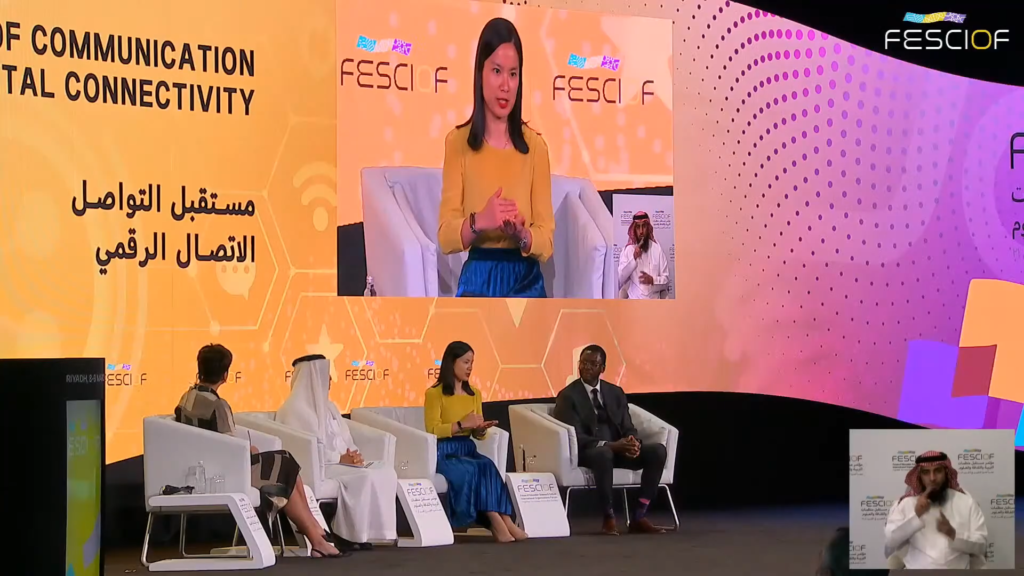
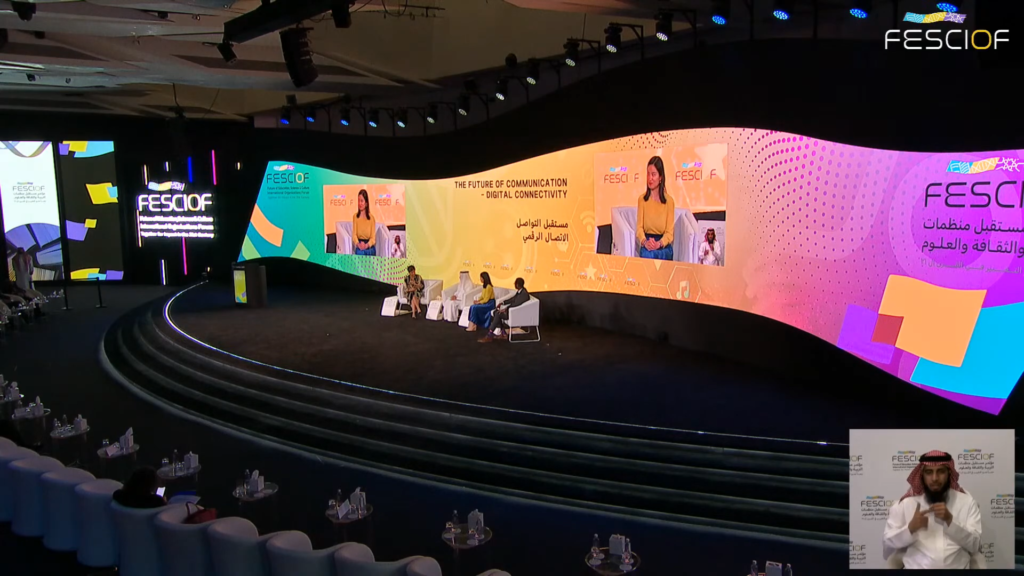
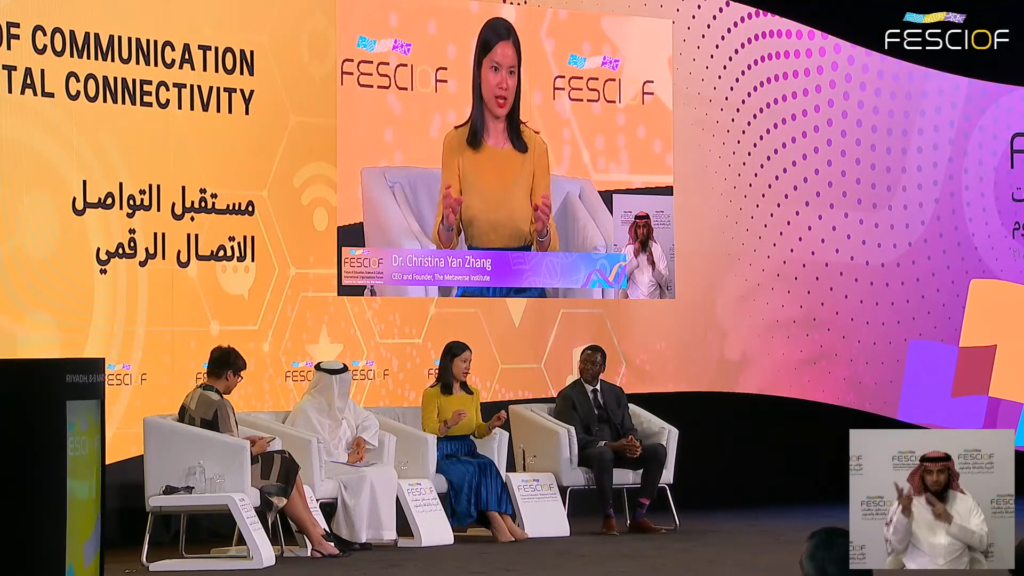
Dr. Christina Yan Zhang, CEO and founder of The Metaverse Institute in the UK, speaks during a session at FESCIOF. (AN photo)
Expert praises Kingdom’s use of metaverse in presenting smart cities
“When you have this strong digital platform, everyone will participate,” Culture Ministry official says
RIYADH: Saudi Arabia has been praised for its use of digital technology to present smart city developments to prospective investors.
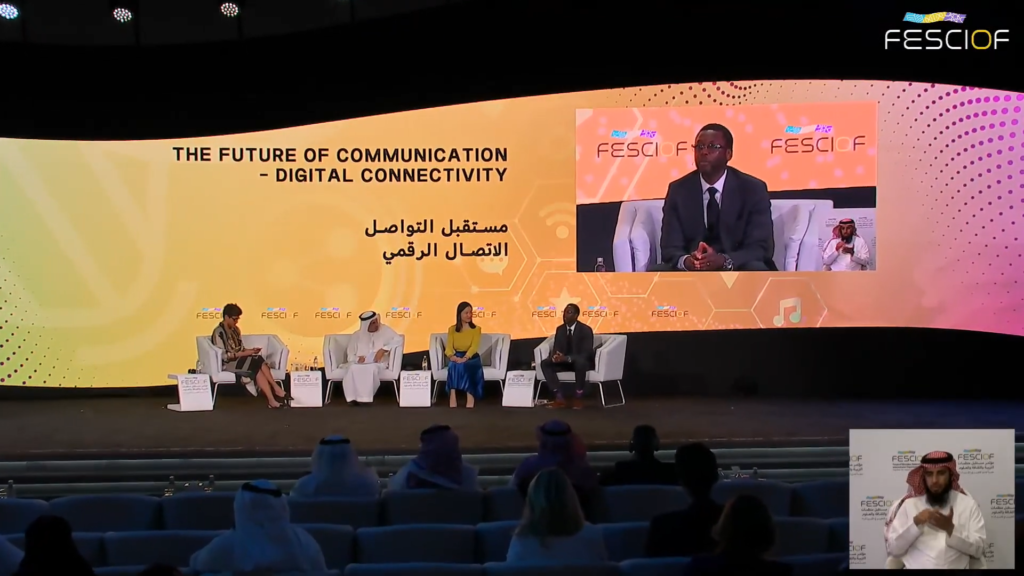
Speaking on Wednesday at the Future of Education, Science and Culture International Organizations Forum (FESCIOF), CEO and founder of The Metaverse Institute in the UK, Dr. Christina Yan Zhang said the Kingdom was embracing the technology.
“In Saudi Arabia, we have many amazing smart city projects, where we use digital today in the metaverse environments to simulate the whole city,” she said.
“Even before the city is constructed, all citizens who are planning to move to a city, either here in Saudi Arabia or from other parts of the world, they can see how the city is going to look like, either as public transport or housing or health care or as fiction.”
She said that the metaverse brought together a range of new technologies to create an intuitive, immersive and interactive interface that was very user-friendly.
“We are seeing the hallmark of this icon system through things like artificial intelligence, 5G connections, cybersecurity and different user interfaces like VR, AR, XR,” Zhang said.
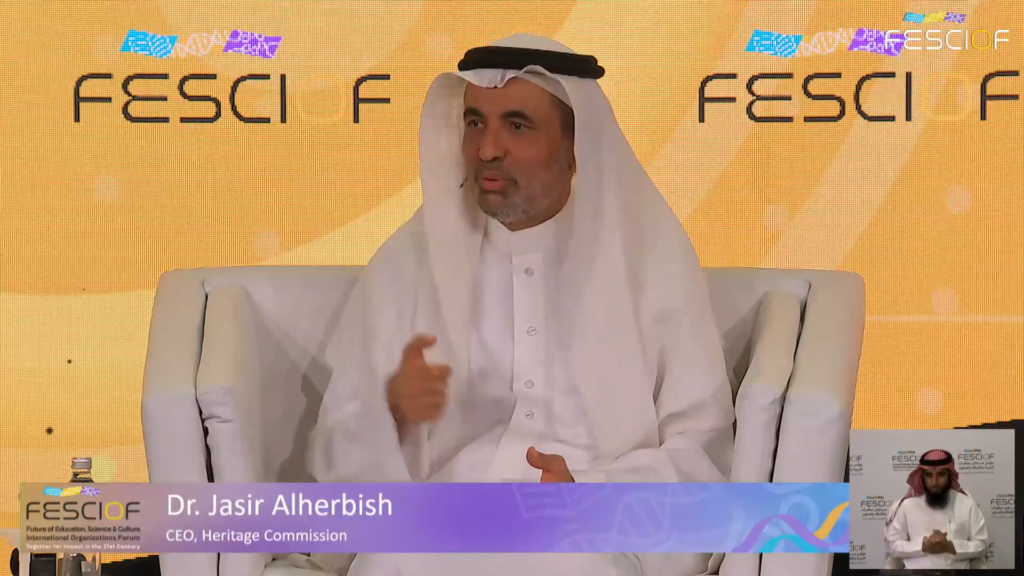
Jasir Alherbish, CEO of the Heritage Commission at the Saudi Ministry of Culture, said: “When you have this strong digital platform, everyone will participate. These technological advancements help us manage our sciences.”
Lawrence Eta, vice president of digital analytics at the Royal Commission of AlUla, said the point of the conference was to discuss the future of education and sciences, and the need for digital literacy.
He said in AlUla the RCU was working closely with telecommunications providers to develop the infrastructure needed to be able to present the region and its culture to the outside world.
“AlUla is the size of Belgium, so the first thing we have to have is internet penetration.”
He added that digital connectivity allowed telecommunications to bring value to the world.
“For example, let us take a look at autonomous pods. It is less about the autonomous cars and more about the digital economy that’s being created, because now we have local people in AlUla that are actually powering those ports.”
Arab News, Saudi Arabia’s first English language daily newspaper was founded in 1975 and has become the Middle East’s leading English daily. It is one of 30+ brands by Saudi Research and Media Group (SRMG). From 2016 with the joining of Faisal J. Abbas as the Editor-in-Chief, Arab News has gone through major digital transformation and a complete rebranding to become popular not only among Saudi Arabia’s society and the Arab World, but also reaching policy makers and business leaders in the United States and the United Kingdom making it one of the primary sources in the Arab World to be quoted by US and UK media outlets and policy makers. Because of its wide readership profile with over 10 million website monthly readers, it is a much sought-after medium for advertising and brand building. It is a pioneer and has developed unique content, shows and programs becoming the first, what was once a traditional newspaper, to produce video talk shows and radio shows, including: Frankly Speaking video show hosted by Katie Jensen, digs deep into the insights of some of the most important policy makers and business leaders in the Middle East and Worldwide. The Mayman Show is a personable podcast by Arab News hosted by reporter Hussam Al-Mayman. The show revolves around personal and relatable conversations between the host and his celebrity guests that include actors, comedians, models, athletes and more.
Dr Christina Yan Zhang, CEO of The Metaverse Institute. She is a pioneer in the metaverse. She started her master dissertation on the topic in 2006 using metaverse to develop international strategies for universities worldwide and completed a PhD with full scholarship in using digital twin services in the metaverse to augment the AEC industry in 2012. Christina is an award-winning business leader who has 16 years’ experience turning forward-thinking ideas into ultra-high growth business with global impact. She has extensive experience working with government ministers, universities presidents, and business CEOs on industry, innovation, and skills strategies. Christina was the first Chinese elected to the national executive of the UK National Union of Students (NUS) since 1922 and represented the interests of one million international students studying at 600 UK higher and further education institutions who contribute £30bn a year to the UK economy. She has sat on more than 20 advisory committees for UNESCO, the World Bank, the Commonwealth, the EU, and UK Governments among many others. She has led many successful lobbying efforts with government leaders, including former UK Prime Minister Theresa May on immigration changes. Christina also contributed to the establishment of the Commonwealth Students Association, representing 2 billion youth across 54 countries. Between 2012 and 2013, she worked in the UK Parliament developing policy for the Shadow Business Secretary’s team.
On 17th December, I chaired a discussion on Twitter Spaces with four distinguished experts in the metaverse, blockchain and digital technology. Our topic was: Is there still a point in entering the metaverse? Nearly 2,000 attendees tuned in; so, I guess that many people are asking this question.
Since Facebook changed its name to Meta in October 2021 and announced it would invest $100bn in the space, there has been enthusiasm worldwide about the metaverse. McKinsey & Company predicts that the metaverse-related economy could be worth $5 trillion by 2030. Some would argue 2022 was a year when the metaverse saw continuing growth in interest, while others would point out the bursting of some significant bubbles. NFT sales have dropped by 97%. Crypto is facing tough regulatory questions after the collapse of FTX. The share price of Meta has slumped 70% since its peak; a business worth $1 trillion in September 2021 is now valued at $310bn, and the company laid off 11,000 employees this year, 13% of the total.
Matthew Ball, tech investor and author of The Metaverse: How It Will Revolutionise Everything, says: “A year ago, it was mostly ‘What is the metaverse?’ Questions now are a lot more practical: ‘What will be here? When? For whom? How, and why?’”
Looking back at the year, what lessons can we learn to help us build a sustainable, inclusive and equitable metaverse ecosystem in the future?
The Definition of the Metaverse
The term ‘metaverse’ is nothing new. Author Neal Stephenson coined the word in his 1992 science-fiction novel ‘Snow Crash’, which envisions a virtual reality-based successor to the internet. In the novel, people use digital avatars of themselves to explore the online world.
The First Wave of the Metaverse
The 2003 virtual world Second Life is often described as the first metaverse. Second Life allowed people to create an avatar for themselves and have a parallel life in an online virtual world. Developed and owned by the San Francisco-based firm Linden Lab and launched on June 23, 2003, it saw rapid growth for some years and in 2013 it had approximately one million regular users. It is still going strong as of 2022, with around 900,000 active users.
I was lucky to be one of the early adopters of the metaverse, in 2006. I saw it as the next generation of the internet, and both my Master’s degree and PhD were focused on using the metaverse to help education institutions develop their international strategy, and on how architects, engineers and the construction industry can use VR and AR simulations.
The Second Wave of the Metaverse
The metaverse we talk about today is actually the second attempt at mass adoption. It started with a successful IPO of Roblox in March 2021, which achieved a market value of $38bn. The excitement about the metaverse really ramped up after Facebook changed its name to Meta in October that year.
Now, the metaverse has become a convergence of a whole range of cutting-edge technologies, which together will form the next generation of the internet. These include better and faster IT infrastructure, such as 5G and 6G mobile networks; new user interfaces such as XR, wearables, haptics, and voice/gesture recognition; and new computing technologies such as spatial, edge and quantum computing. There are also new information-organising tools such as AI and machine learning; digital-finance technologies such as blockchain, NFTs, and cryptocurrency; and new forms of social interaction online, such as e-sports, virtual events and gaming. Many of these developments are interrelated or even interdependent, but it is still uncertain what shape the emerging ecosystem will take. Nevertheless, it seems inevitable that many of these elements will combine to make the internet more immersive, interactive and intuitive.
Entrepreneur Jon Radoff has proposed seven fundamental layers of the metaverse. This is a good starting point to understand the ecosystem.
Challenges and possible solutions
IT infrastructure and computing power
Currently, the technology does not exist for hundreds or millions of users to participate in a shared concurrent experience in the metaverse. Although some metaverses with high concurrencies have existed for decades, such as Second Life, they essentially spoofed the experience by “sharding” and splitting users into different “worlds” and servers. As a result, a player only really sees or interacts with a small handful of other players at any one time.
Intel’s Raja Koduri has said that computer chips would need 1,000 times their current power to support a true metaverse.
To achieve the full potential of a metaverse where millions of users can interact concurrently, quantum computing could be a solution. This year’s Nobel Prize was awarded for groundbreaking research on quantum entanglement, which could potentially make it possible to create the IT infrastructure to realise the full potential of the metaverse.
Quantum computers could potentially be much, much faster than our fastest computers today. And the top IT firms involved in developing quantum computing, such as IBM, Nvidia, Microsoft and Google, are also involved in building the metaverse. It would be interesting to see the more powerful computing power in place soon to provide the necessary IT infrastructure to allow the metaverse to flourish.
Virtual ‘Ghost towns’ – active user decline in consumer-focused metaverses
According to Decentraland, their “goal is to be a fun and entertaining platform with a thriving community that educates and onboards people to the philosophies and tech of Web3.” This is a good business model during time when the consumer wants to spend more time having fun and entertain themselves. However, during a time when the world is likely heading for recession, 75% of consumers are trading down across categories, according to McKinsey, 38% respondents are cutting Entertainment spending. Entertainment focused metaverse would also be affected by the recession.
“Consumer facing metaverses need to create solid social reasons for people to consistently visit the platform. The ‘ghost town’ issue is nothing new. When I was doing my PhD research on the world’s first metaverse Second Life in 2006, similar issue always exists. Unless there are major events, many parts of the digital world are less populated”. “For the metaverse to flourish, it needs to bring real world commercial value and social impact. That is what we, at The Metaverse Institute are doing, help organisations to use the metaverse tech to improve the real world.”
There are no easy solutions here. Existing, well-established retail and entertainment venues in the real world, such as cinemas and shopping malls, can expect declines in their business during downturns – so it will be especially challenging to launch new online venues in these fields when customers are feeling the pinch. Consumer-focused metaverses may simply have to wait until the broader economy recovers.
An alternative starting point: Enterprise-focused metaverses
Given the economic climate, it is more likely that this new internet will grow out from the corporate sector, which has the resources to invest through the downturn. That means a focus on enterprise solutions. The second wave of the metaverse will look less like ‘Second Life’, and more like ‘Second Work’ – at least in the short term.
Led by big tech such as Meta, Google, Apple, Microsoft, Nvidia etc, billions of people who already use the enterprise service for daily work would find the transition to the metaverse faster and smoother.
For example, Meta and Microsoft have announced a metaverse partnership focused on the future of work. “Both companies view the metaverse as the next stage of workplace collaboration. Meta can capitalise on Microsoft Office’s loyal 1.2 billion users, while Microsoft benefits from Meta (nearly 3 billion monthly active users) to boost its own enterprise metaverse and VR gaming ambitions.” Microsoft’s Work Trend Index data shows that 50% of Gen Z and millennials envision doing some of their work in the metaverse in the next two years.
Another major leader in the enterprise metaverse is Nvidia. Backed by more than 3.5 million developers creating some 3,000 accelerated apps, Nvidia has also launched Omniverse Cloud Services, a metaverse-as-a-service cloud that is used for Building and Operating Industrial Metaverse Application. They already work with more than 200 big enterprises worldwide from telecom, to energy, advanced manufacturing, to defence and aerospace. Amazon, AT&T, BMW, Ericsson, Foxconn, GM, Kroger, Siemens, Sony, Universal Robots, and Lockheed Martin are among some of the big enterprises using Omniverse to model reality (as digital twins) in the metaverse to improve operations and designs.
Digital Identity for both human and AI avatars
Digital identify is another key issue needs to be addressed before mass adoption. In addition to the digital identify of human being, there is also increasingly an issue of the digital identify of AI avatar. Since most people cannot live 24/7 in the metaverse, increasingly, a large number of avatars would be created using AI to populate the metaverse provide guidance, service and support to human avatars to make the best of their experience in the virtual world.
This year, Google and Meta demonstrated new text-to-video AI systems, focusing on quality and length with interesting results. My business partner Alan Boyd has announced in September 2022 at a metaverse conference I organised and chaired in London on the world’s first Digital Autonomous Lifeforms (DAULs), AI virtual assistants that are “Born on the Blockchain, Live in the Metaverse” who could provide 24/7 support to human to navigate the metaverse.
Consider the popularity of generative AI, for example, ChatGPT, once this technology is used to create large number of avatars in the metaverse, combined with voice recognition and gesture recognition, how could we clearly define the digital identity of human and AI avatars in the metaverse. If anything goes wrong with the AI avatars that cause harm to human avatars, who would be legally liable?
Currently this issue has not really been much discussed in the public domain. Digital identity of human avatar is an unresolved issue that regulators worldwide have been working hard to solve. The rise of digital identity of AI avatar would pose more complexity to the debate.
Some countries already start to legislate on generative AI. In December 2022, Chinese authorities have passed a regulation on “deep synthesis” technology, which includes technology that uses deep learning, virtual reality, and other synthesis algorithms to generate text, images, audio, video, and virtual scenes.” The new laws will go into effect from January 10th, 2023, and effectively require any AI-generated images to have a watermark that defines them as such. The rules ban people from using deep synthesis tech to generate and disseminate fake news. Platforms also must remind users to get permission before they alter others’ faces and voices using deep synthesis technology.
Conclusion
If 2021 was the start of the second wave of the metaverse, then 2022 was the year it got a reality check. Consumer-focused environments are likely to struggle as long as economic hardship persists, while IT and computing power needs to develop significantly to build a truly immersive experience. Meanwhile, following the high-profile cryptocurrency collapses, the question of how to monetize metaverse experiences – whether that happens through blockchain-based digital assets, digital fiat, or bespoke in-world currencies – remains very much open.
But the next generation of the internet is still in development. A fully immersive VR world of the kind envisaged in science fiction, which is used daily by billions, will not arrive any time soon. But workable enterprise applications, such as digital twin technology, are already being used at scale. These will help drive investments in network infrastructure, which in turn will help spur the next generation of consumer-focused metaverses, perhaps when the economic outlook is better.
Looking back over 2022, I remain positive about the metaverse’s future development. At the Metaverse Institute we are here to assist you in your journey exploring the next generation of the internet and using it to spur commercial success and social impact in the real world.