
The UN Call for Consultation
The United Nations is inviting global stakeholders to a milestone public consultation on its first pre-implementation tool for AI and virtual worlds in urban environments. This framework serves as a strategic bridge for cities, providing the necessary standards and risk-assessment protocols to deploy Citiverse technologies safely and inclusively.
Bridging the Gap
From 2D Intelligence to 3D Reality This initiative arrives at a critical juncture as AI evolves from 2D Large Language Models (LLMs)—which process text and code—into 3D Large World Models (LWMs) that understand physical space. While 2D AI has transformed how we manage information, 3D LWMs provide the spatial common sense required to build a people-centered, planet-friendly digital future. By integrating these advancements, the UN framework ensures that cities dont just build virtual replicas, but use intelligent 3D environments to simulate climate resilience, optimize resources, and guarantee inclusive access before a single physical brick is laid.

The 2025 Pivot to Physical: A Strategic Briefing on Large World Models (LWMs)
The AI industry is reaching a definitive turning point in 2025. The era of scaling pure language models is evolving into a pursuit of Artificial General Intelligence (AGI) through Large World Models (LWMs).
Unlike their predecessors, LWMs are engineered to perceive and simulate the 3D physical world—mastering geometry, physics, and complex cause-and-effect relationships. This technological evolution provides the critical link to a people-centered, planet-friendly digital future: by moving from 2D text to 3D spatial intelligence, the Citiverse can now simulate real-world environmental impacts and human needs with unprecedented accuracy.
The global race has shifted: the leaders of tomorrow will be those who successfully build this ‘common sense’ layer, allowing AI to understand and interact with the physical reality we inhabit to solve our most pressing urban and climate challenges.

1. NVIDIA: The “Cosmos” Ecosystem – Architecting the Physical AI Stack
Core Philosophy: NVIDIA is successfully transitioning from a semiconductor leader to the definitive “operating system for the physical world.” By moving beyond 1D language processing, NVIDIA is building the spatial “common sense” required for AI to inhabit and interact with 3D reality.
Measurable Developments & Strategic Impact:
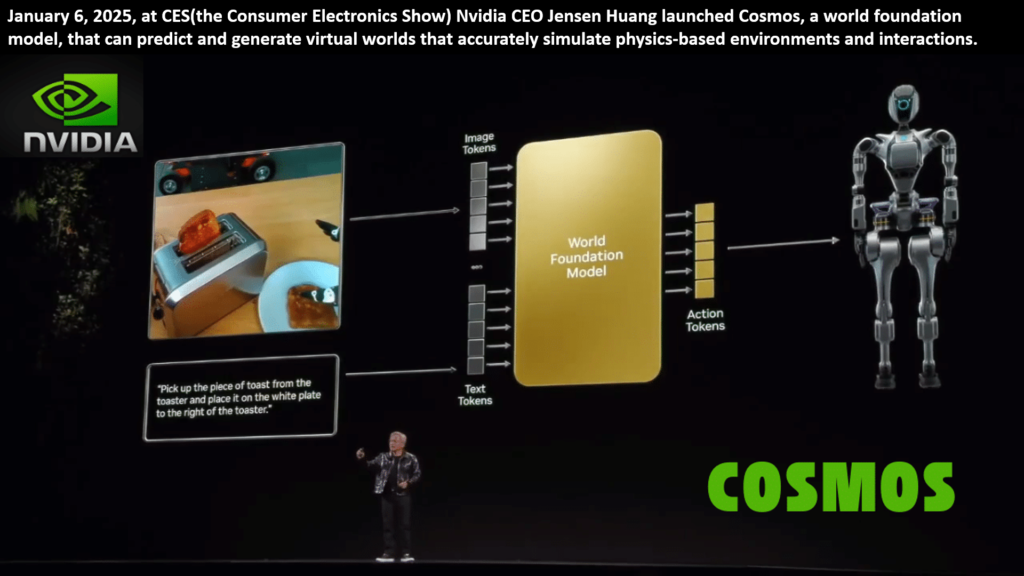
- Launch & Scale of Project Cosmos: Unveiled in early 2025, NVIDIA Cosmos is a unified platform for World Foundation Models (WFMs). These models are trained on over 20 million hours of real-world video, allowing AI to master object permanence and physically based interactions across industrial and urban settings.
- The 12x Performance Breakthrough: A cornerstone of this stack is the NVIDIA Cosmos Tokenizer. It delivers 8x more total compression and processes data 12x faster than previous industry standards. This speed allows for the real-time generation of physically accurate world states, transforming years of data processing into just weeks.
- The $50 Trillion Opportunity: CEO Jensen Huang has identified Physical AI as the catalyst for a $50 trillion revolution in manufacturing and logistics. NVIDIA’s “three-computer” architecture—DGX for training, Omniverse for simulation, and AGX for deployment—serves as the essential infrastructure for this transition.
- Synthetic Data & The GR00T Blueprint: In March 2025, the Isaac GR00T Blueprint demonstrated a paradigm shift in training efficiency. NVIDIA generated 780,000 synthetic robot trajectories in just 11 hours—a task that previously required 9 months of human demonstration. This synthetic data injection boosted robot performance by 40%.
Synthesis: Why this Matters for the Citiverse
NVIDIA’s 2025 advancements provide the high-fidelity engine for the UN’s Citiverse initiative. By replacing statistical guesses with physically grounded simulations, cities can use NVIDIA’s stack to:
- Eliminate Risk: Use Cosmos Predict to simulate traffic impacts before a single physical change is made.
- Scale Inclusivity: Train urban service robots using GR00T synthetic data to ensure they navigate diverse neighborhoods safely.
- Drive Sustainability: Leverage Omniverse to optimize energy grids and climate resilience with scientific precision.
Watch NVIDIA’s 2025 Physical AI Keynote
This video provides a deep dive into NVIDIA’s 2025 “Cosmos” announcement, demonstrating how visual tokenizers and world foundation models are being used to train the next generation of physical AI.
2. World Labs (Fei-Fei Li): The Venture-Backed Bet on Spatial Intelligence
Core Philosophy: Spearheaded by Dr. Fei-Fei Li, World Labs is moving AI beyond “wordsmiths in the dark” to systems that possess Spatial Intelligence. The goal is to endow AI with a “North Star” of physical grounding—the ability to link imagination, perception, and action in 3D worlds.
Measurable Developments & Impact:
- Commercial Launch of Marble: In November 2025, World Labs moved from research to product with the public launch of Marble, their first commercial World Model.
- Funding & Valuation: Following a $230 million Series A in late 2024, World Labs entered 2025 with a “unicorn” valuation exceeding $1 billion. Investors include heavyweights like Andreessen Horowitz (a16z), Radical Ventures, and NVentures (NVIDIA), signaling a unified industry bet on spatial AI.
- The RTFM Breakthrough: In October 2025, the team integrated RTFM (Real-Time Frame Model) into Marble. This allows the system to generate and render 3D space in real-time as a user interacts with it, effectively serving as a “spatial memory” that maintains world consistency even as a user explores endlessly.
- Ecosystem Integration: World Labs has already secured partnerships to power spatial learning (EON Reality) and is compatible with mainstream XR hardware like Apple Vision Pro and Meta Quest 3, positioning its world models as the primary content engine for the spatial computing era.
Synthesis: Why this Matters for the Citiverse
Fei-Fei Li’s “Spatial Intelligence” provides the human-centric interface for the Citiverse. While NVIDIA provides the industrial backbone, World Labs enables:
- Democratized Design: Allowing non-technical city planners to “sketch” a new public square and immediately walk through it in 3D to evaluate social inclusivity.
- Visual Grounding: Ensuring that Citiverse AI isn’t just hallucinating data, but is grounded in the actual 3D layout and “interact-ability” of a specific urban neighborhood.
- Embodied Learning: Providing the high-fidelity simulators needed to train the next generation of urban service robots in a safe, virtual environment.
This interview with Fei-Fei Li explores the shift from language-centric AI to spatial intelligence and the “world modeling” phase of the industry.

3. Google DeepMind: AGI via Scientific Simulation and Generalist Agents
Core Philosophy: Google DeepMind operates on the conviction that “World Models are the prerequisite for AGI.” CEO Demis Hassabis advocates for a balanced path where AI doesn’t just predict text, but understands the fundamental physical laws of the universe. This “spatial common sense” is the foundation for creating agents that can safely navigate both virtual and real-world cities.
Measurable Developments & Impact:
- SIMA 2: The Generalist Urban Agent: In November 2025, DeepMind released SIMA 2 (Scalable Instructable Multiworld Agent). Unlike standard AI, SIMA 2 can follow complex, natural-language instructions in 3D environments (e.g., “Find the nearest recycling point”) by perceiving the world like a human. It demonstrates a 2x performance leap in task success over its predecessor.
- Genie 2: The Interactive World Engine: Launched in late 2025, Genie 2 is a foundation world model that can generate physically consistent, interactive 3D environments from a single image. This serves as the “infinite training ground” for Citiverse simulations, allowing city planners to generate millions of “what-if” scenarios for urban traffic or emergency response.
- The “Scientific Research Closed Loop”: DeepMind has successfully pioneered an AI Co-Scientist framework. In 2025, this system used world models to simulate millions of parallel experiments in materials science, leading to the discovery of new superconductor materials and more efficient battery chemistries for green city grids.
- Strategic Resource Allocation: To bridge the gap between theory and reality, DeepMind maintains a strict 50/50 resource split:
Synthesis: Why this Matters for the Citiverse
Google DeepMind provides the analytical brain of the Citiverse. While other players focus on the “view,” DeepMind focuses on the “logic” of the city:
- Smarter Public Services: Using SIMA 2 logic to power helpful, safe AI agents that assist citizens in navigating complex urban services.
- Climate Resilience: Leveraging WeatherNext 2 to simulate local micro-climates within the Citiverse, allowing cities to prepare for extreme weather with hour-by-hour precision.
- Automated Urban Policy: DeepMind’s work with the UK government on “Extract” transforms legacy planning documents into digital data in 40 seconds (down from 2 hours), accelerating the “ex-ante” evaluation process.
AI’s Next Frontier: World Models Explained
This video provides an expert breakdown of why the shift to world models is considered the “next frontier” for AI and how it enables deeper interaction with our physical environment.

4. Yann LeCun’s New Venture (AMI): The Bet on Non-Generative World Models
Core Philosophy: Yann LeCun asserts that Large Language Models (LLMs) are a dead end for AGI because they lack physical grounding. He advocates for Advanced Machine Intelligence (AMI)—systems that learn like a human (or even a house cat) through observation and interaction, rather than just predicting the next word in a sentence.
Measurable Developments amp; Impact:
- The Great Decoupling: In late 2025, Yann LeCun announced his departure from Meta to found Advanced Machine Intelligence (AMI) Labs. This move crystallized a philosophical split: while Meta’s Superintelligence Lab doubles down on generative models (Project Mango and Avocado), AMI Labs is dedicated to non-generative World Models.
- The €3 Billion Valuation: Despite being pre-product, AMI Labs is targeting a valuation of €3 billion ($3.5 billion), securing early support from European and Silicon Valley investors who view spatial intelligence as the next multi-trillion-dollar frontier.
- Technical Foundation (JEPA): The venture is built on the Joint Embedding Predictive Architecture (JEPA). Unlike generative AI that hallucinates pixels, JEPA-based models learn to predict latent features—the underlying rules of physics, geometry, and causality—within video and spatial data.Leadership amp; Structure: LeCun serves as Executive Chairman, bringing on Alexandre LeBrun (founder of Nabla) as CEO. Based in Paris, the lab is positioned as a European hub for AGI research that remains independent of the generative hypnosis of Silicon Valley.
- Ecosystem Partnership: Meta remains a technical partner, providing compute resources and datasets, while AMI Labs pursues high-stakes applications in robotics, transportation, and autonomous urban services.
Synthesis: Why this Matters for the Citiverse
Yann LeCun’s AMI Labs provides the reliability layer for the Citiverse. While generative models are good for visualizing ideas, JEPA-based models are required for governing physical spaces:
- Hallucination-Free Planning: JEPA models do not make things up; they predict physical reality. This ensures that Citiverse traffic simulations are based on the actual laws of motion, not statistical guesses.
- Autonomous Urban Maintenance: For robots to clean streets or fix infrastructure, they need the common sense to understand that a cardboard box is empty but a glass bottle is fragile—a level of reasoning AMI Labs aims to solve.
- Sustainable Logistics: By mastering cause-and-effect, these models can optimize city-wide logistics and supply chains with a degree of physical accuracy that LLMs cannot reach.
Yann LeCun on Self-Supervised Learning and World Models
In this lecture, Yann LeCun provides the deep technical reasoning behind why current AI models fail at physical tasks and how his JEPA architecture serves as the foundation for future “World Aware” systems.

Why This Matters Now
The AI industry is undergoing a foundational pivot: we are moving from AI that talks to AI that understands and acts within the physical world.
In 2025, success is no longer measured by text fluency or the ability to mimic human conversation. Instead, the new benchmarks for intelligence are simulation accuracy, spatial reasoning, and the ability to solve high-stakes challenges in the real world—from autonomous robotics to the discovery of new sustainable materials.
The New Frontier of AGI
The race to Artificial General Intelligence (AGI) has officially become a race to build the best World Model.
- Beyond Book Smarts: While 2D models are book smart, they lack the street smarts needed to navigate a complex urban environment safely.
- Physical Mastery: Success now depends on an AI’s ability to master the common sense of our reality—geometry, physics, and cause-and-effect.
- Industrial Transformation: This shift is already redefining a $50 trillion economy, transforming how we design cities, manage global supply chains, and protect our planet.
The concept of using persistent 3D virtual worlds to simulate dangerous, expensive, or life-threatening scenarios—what some have called the “metaverse”—has never fundamentally changed because it addresses a basic human necessity: to model, understand, and solve complex systemic problems before confronting them in reality.
The branding may shift—from Digital Twins and CAD/BIM to Spatial Computing and Large World Models—but the core mission remains constant. What was dismissed as a “dead metaverse” was merely the premature packaging of this essential capability, lacking the foundational AI required to make it real.
The Unchanging Why: The Necessity of Safe Simulation
We have always needed to:
- Test aircraft designs without crashing them.
- Practice complex surgeries without risking lives.
- Model climate impacts without waiting decades.
- Plan cities without costly physical prototypes.
- Train soldiers and first responders without real danger.
This isn’t entertainment—it’s civilizational infrastructure. The most complex systemic challenges of our time—climate adaptation, pandemic response, fusion energy development, resilient supply chains—cannot be solved through trial and error in the physical world. They require infinite, risk-free experimentation in parallel simulated worlds.
How Large World Models (LWMs) Finally Deliver on the Decades-Old Promise
Previous tools like CAD or BIM created static models. LWMs create living simulations with inherent understanding of physics, cause-and-effect, and 3D space. Here’s the transformation:

The Fundamental Shift: From Building Worlds to Growing Ecosystems
LWMs don’t just create prettier virtual spaces—they create credible alternative realities where systemic relationships can be understood:
- Emergent Behavior Modeling: Simulate how a new financial policy affects not just markets but urban development, traffic patterns, and social dynamics over 20 years.
- Crisis Compression: Run 1,000 years of pandemic variants in a week to identify robust public health strategies.
- Existential Risk Testing: Model asteroid deflection scenarios or geoengineering climate interventions with full atmospheric, oceanic, and ecological feedback loops.
Conclusion: The Simulated Layer of Civilization
The “metaverse” branding may fade, but the simulation imperative grows more urgent. LWMs are becoming the operating system for pre-emptive problem-solving—the indispensable layer where we work through our most dangerous, expensive, and complex challenges.
What we’re witnessing isn’t the rebirth of a failed consumer trend, but the maturation of humanity’s most critical cognitive technology: our ability to create parallel realities where failure is instructive, not catastrophic. Whether called industrial metaverse, spatial intelligence, or Large World Models, this capability is transitioning from optional to essential infrastructure—the proving ground where we solve problems too big, dangerous, or expensive for our single physical reality to bear.
The fundamental proposition remains unchanged and more vital than ever: If we cannot safely simulate our systemic crises, we cannot survive them. LWMs are the first technology suite capable of delivering on this proposition at civilization-scale.
UN Initiative on Metaverse and Citiverse
UN Task Group for The Pre-standardisation for the Citiverse
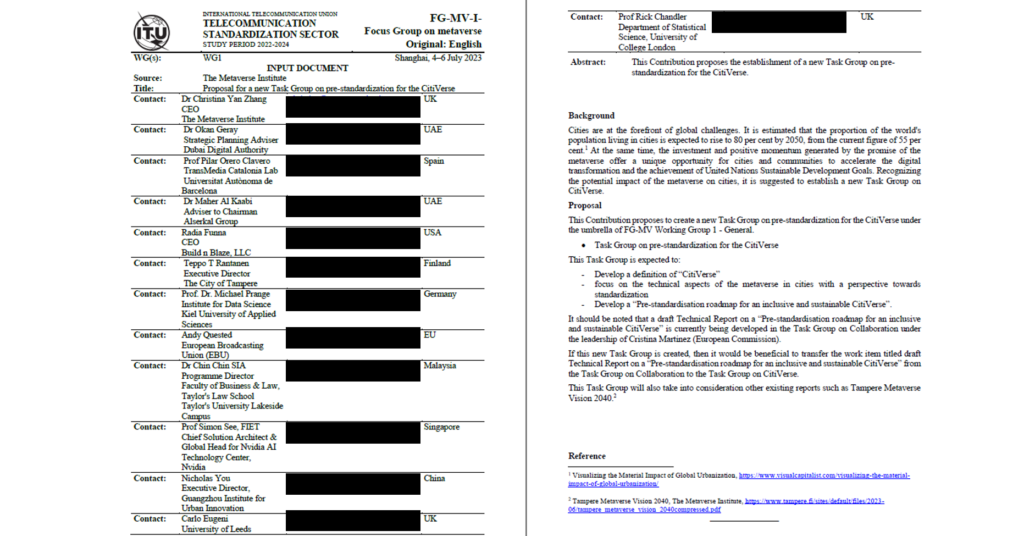
In Feb 2023, The Metaverse Institute submit a proposal to The International Telecommunication Union to set up a new task group for the Pre-standardisation for the Citiverse together with a group of other supporting organisations including Digital Dubai, The City of Tampere, Nvidia etc. This was approved in July 2023. I was appointed co-chairman alongside Cristina Martinez, then Deputy Head of Smart Technologies for communities at European Commission, leading the EU Citiverse initiative.
We have been heavily involved in the development of the UN metaverse standardisation process around the metaverse and citiverse. The UN approved definition of Metaverse was approved in Dec 2023 as the following:
“An integrative ecosystem of virtual worlds offering immersive experiences to users, that modify pre-existing and create new value from economic, environmental, social and cultural perspectives. NOTE – A metaverse can be virtual, augmented, representative of, or associated with the physical world.

I am one of four co-authors who wrote the UN definition of the metaverse.

According to the ITU Technical Report “Definitions of CitiVerse” (approved June 2024), the term is defined as:
- The Simplified Definition: “Metaverse for cities.”
- The Complete Definition: “Metaverse for cities, prioritizing a human-centred approach and promoting sustainable development “

For the UN definition of citiverse, I am one of four contributors acknowledged in the document.

As Co-chairman of the UN Task Group for The Pre-standardisation for the Citiverse, I authored the first UN technical report on the Building a “People-centred Citiverse” which was approved in July 2024.

In the first UN report on the citiverse, we introduced eight levels of entry points for stakeholders to start their citizen-centred digital futures using AI and digital twins powered simulations.
The Global Initiative on Virtual Worlds and AI – Discovering the Citiverse
The Global Initiative on Virtual Worlds and AI – Discovering the Citiverse is a global multistakeholder platform launched by the International Telecommunication Union (ITU), the United Nations International Computing Centre (UNICC), and Digital Dubai in July 2024, and supported by more than 70 international partners.
The Initiative aims to shape a future where AI-powered virtual worlds are inclusive, trusted, and interoperable. By connecting people, cities, and technologies, it empowers meaningful progress through AI-powered virtual worlds.

“Preparing for the Citiverse(Virtual Worlds and AI for Cities)- a Checklist to Evaluate Pre-Implementation”
This development of this deliverable “Preparing for the Citiverse – A Checklist to Evaluate Pre-Implementation ” is led and coordinated by myself, Dr Christina Yan Zhang, CEO of The Metaverse Institute, as the leader for Track 5 – Evaluation and Assessment at The Global Initiative on Virtual Worlds and AI – Discovering the Citiverse.
A very special thank you to Nicholas You, Executive Director at Guangzhou Institute of Urban Innovation, a world-renowned leader of best practices for cities with decades of UN experience, and the Founder and Honorary Chairman of the Steering Committee of the UN-Habitat World Urban Campaign. Nicholas’s visionary insight in proposing the practical tool for mayors laid the foundational idea for this crucial deliverable.
A tremendous acknowledgment to Dino Cataldo Dell’Accio, Deputy Chief Executive United Nations Joint Staff Pension Fund, whose brilliant architectural expertise was fundamental in developing the core of this tool, and who graciously submitted it on behalf of Track 5 to the Secretariat, bringing Nicholas’s foundational concept to life through meticulous development.

We also want to express our profound gratitude and immense pride in each and every one of our 27 distinguished world leading authorities in Track 5 Evaluation and Assessment for their dedication, intellectual rigor, and collaborative spirit have made this Mission Impossible possible:
🌟Karl-Filip Coenegrachts, Chair of Open & Agile Smart Cities & Communities (OASC)
🌟Ernesto Faubel-Cubells Faubel, Chair of European Digital Infrastructure Consortium on Local Digital Twins on CitiVerse
🌟Jordi Vaquer, Secretary General, Metropolis, World Association of the Major Metropolises
🌟Rafael Escalona Reynoso, PhD, MPA, CEO, Portulans Institute
🌟Bruno Lanvin, President, Smart City Observatory
🌟Madan Oberoi, Chief Safety Adviser, Google
🌟Hema Sridhar, Director Koi Tū Centre for Informed Futures; former Chief Science Advisor, Ministry of Defence, New Zealand
🌟Nicholas You, Executive Director, Guangzhou Institute for Urban Innovation
🌟Philip Allsopp, Co-Chair to Expert Advisory Group on AI, Generative Design and Data, Royal Institute of British Architects (RIBA)
🌟Andras Szorenyi Ph.D., Senior Policy Advisor, Global Cities Hub
🌟Wookyung Jung, Strategy & Policy Advisor, Executive Directorate, INTERPOL
🌟MD KHORSHED ALAM, Senior Data Strategy, AI & Research Specialist UN Tourism🌟Usha Mishra, Chief of Social Policy at UNICEF China
🌟David Castle, University of Victoria and Researcher in Residence, Office of Chief Science Advisor, Canada
🌟Martin Visbeck, CEO of OceanQuest
🌟Cristina Garrido, CEO, Anteverti
🌟Corey Gray, President, Smart Cities Council
🌟Ziad-Alexandre Hayek, President, WAPPP | World Association of PPP Units & Professionals
🌟John Wood, Chairman, Project Advisory Committee of ATTRACT EU, based at CERN
🌟John Omo Secretary General, ATU-African Telecommunications Union
🌟Erdem Samut, CEO, İstanbul Information and Smart City Technologies Company
🌟Takehiko Nagumo, Director, Smart City Institute Japan
🌟Laurence Moroney, Director of AI, Arm
🌟Alvin Wang Graylin, Chairman, Virtual World Society
🌟Dino Cataldo Dell’Accio, Deputy CEO, United Nations Joint Staff Pension Fund (UNJSPF)
🌟Professor Ghassan Aouad, Chancellor of Abu Dhabi University
🌟Owase Jeelani, World-renowned Paediatric Neurosurgeon Gemini Untwined
🌟Hend Alhazzani . SVP, Public Investment Fund, Saudi Arabia


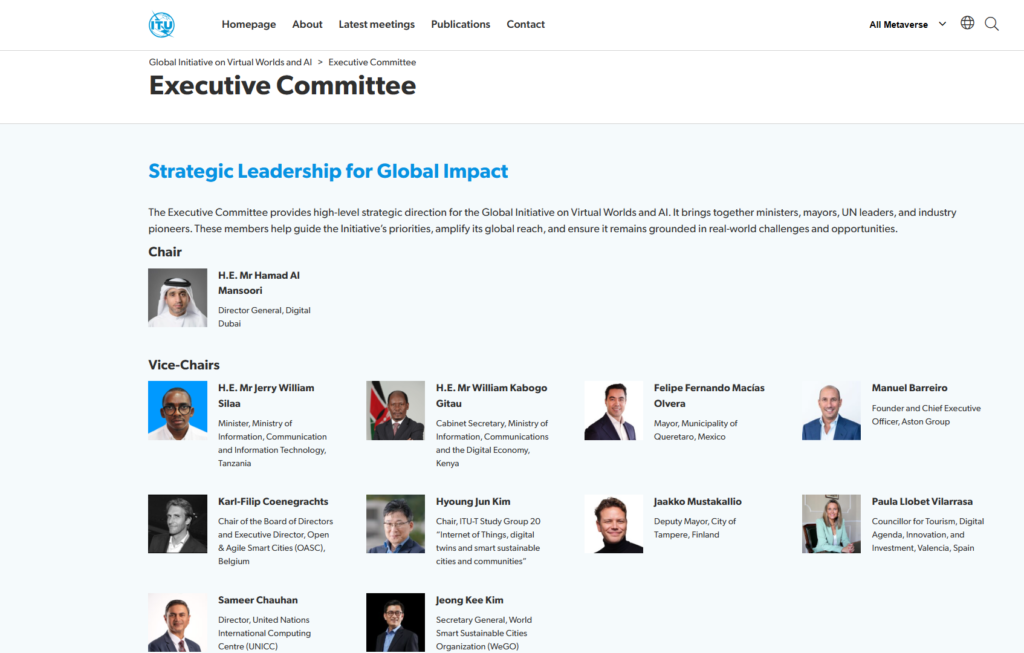
We also extend our sincere thanks to the Executive Committee of The Global Initiative on Virtual Worlds and AI – Discovering the Citiverse for their visionary leadership:
🌟H.E. Hamad Al Mansoori Director General, Digital Dubai
🌟H.E. Jerry William Silaa Minister of Information, Communication and Information Technology, Tanzania)
🌟H.E. Hon.William Kabogo Gitau, E.G.H. Minister of Information, Communications and the Digital Economy, Kenya
🌟Felipe Fernando Macías Olvera, Mayor Municipality of Queretaro, Mexico
🌟Manuel Barreiro Castañeda Chairman Aston Capital Partners
🌟Karl-Filip Coenegrachts Chairman Open & Agile Smart Cities & Communities (OASC)
🌟Hyoung Jun Kim ITU-T Study Group 20 “Internet of Things, digital twins and smart sustainable cities and communities
🌟Jaakko Mustakallio Deputy Mayor Tampereen kaupunki – City of Tampere, Finland
🌟Paula Llobet Vilarrasa Delegate Councilor for Tourism, Innovation, Technology, Digital Agenda and Investment Capture City of Valencia, Spain
🌟Sameer Chauhan CEO United Nations International Computing Centre UNICC
🌟Jeong-kee Kim Secretary General, WeGO | World Smart Sustainable Cities Organization
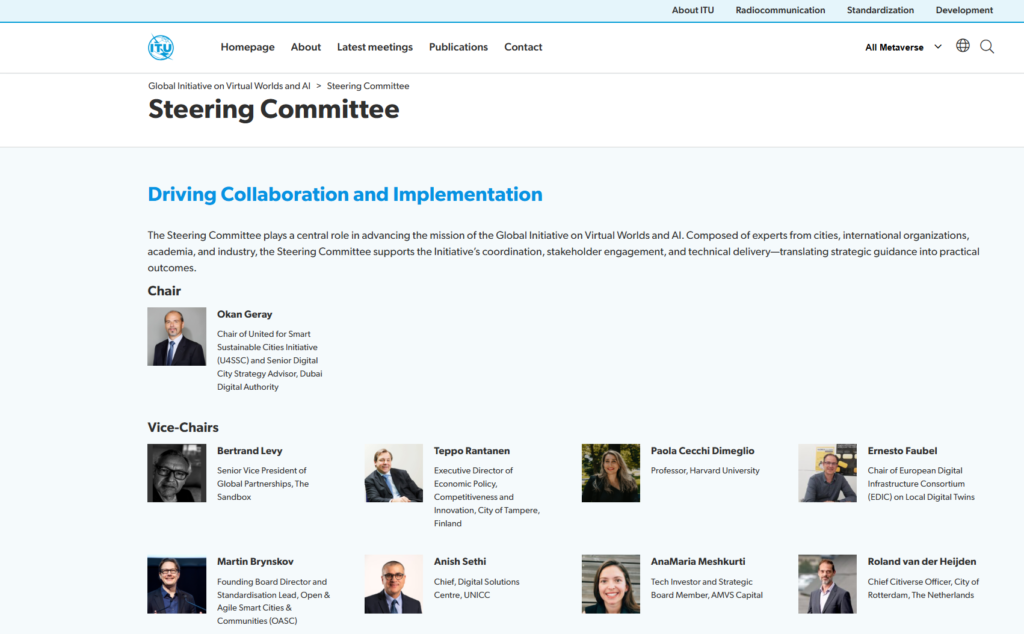
We are also grateful to Steering Committee of The Global Initiative on Virtual Worlds and AI – Discovering the Citiverse for their guidance and support:
🌟Okan Geray Senior Digital City Strategy Advisor Digital Dubai Authority Chair of United for Smart Sustainable Cities
🌟Bertrand Levy SVP The Sandbox
🌟Teppo Rantanen Executive Director Tampereen kaupunki – City of Tampere, Finland
🌟Paola Cecchi-Dimeglio Professor Harvard University
🌟Ernesto Faubel-Cubells Chairman European Digital Infrastructure Consortium LDT CitiVERSE EDIC
🌟Martin Brynskov Founding Board Director Open & Agile Smart Cities & Communities (OASC)
🌟SETHI Anish Chief Digital Solution Centre UNICC
🌟Anamaria Meshkurti Associate Director Middle East AMVS Capital
🌟Roland van der Heijden, Chief Citiverse Officer Gemeente Rotterdam, The Netherlands. Rotterdam Citiverse
Finally, we want to extend our deepest gratitude to the world-class Secretariat of the United Nations especially at the International Telecommunication Union(ITU) and UNICC Their expert stewardship and relentless commitment—far exceeding expectations—have been the catalytic force guiding us through this significant global landmark. We celebrate their continued support and the visionary excellence they bring to the Global Initiative on Virtual Worlds and AI.
Cristina Bueti Counsellor on Smart Sustainable Cities, Citiverse & Virtual worlds ITU
Yining Zhao Junior Communication Officer ITU
Chiara Co Study Group Administration Assistant ITU
Franca Vinci Head Learning Services Porfolio UNICC
Having had the honour to work with them over recent years, we are genuinely touched and consistently impressed by their profound dedication and the exceptional lengths they go to support experts like us. They are truly the unsung heroes who work incredibly hard behind the scenes, providing detailed guidance and unwavering support to every single one of us. It is through their consistent efforts and the amazing opportunity they provide that we have been able to collaborate and develop such an impactful tool for the wider Citiverse Initiative and for mayors globally.
Preparing for the Citiverse- A Checklist to Evaluate Pre-Implementation
This milestone—the culmination of the Citiverse Pre-Implementation Evaluation—stands as a powerful testament to global collaboration and the dedication of experts worldwide.
At its core, the Citiverse embodies a democratic vision for the future of urban life: digital ecosystems that are truly by the people, for the people, and of the people. These human-centric solutions, anchored in planet-friendly foundations, harness technology not as a tool for exclusion, but as a force for universal empowerment.
We are profoundly optimistic about the transformative potential of the Citiverse to assist cities in building inclusive, resilient digital futures. We eagerly anticipate the positive global impact that will follow its widespread adoption.

The Evaluation Framework at a Glance
To ensure rigorous and measurable progress, the framework provides a comprehensive diagnostic toolkit consisting of 130 indicators across 14 strategic domains. Each indicator utilizes a five-level maturity assessment to help cities benchmark their current state and define clear targets for growth.
The 14 Dimensions of Readiness
- Vision: Defining the long-term urban digital roadmap.
- Barriers: Proactively identifying implementation hurdles.
- Use Cases: Prioritizing high-value applications.
- Governance: Establishing ethical and legal guardrails.
- Infrastructure: Ensuring technical and interoperable readiness.
- Data Protection: Safeguarding citizen privacy and sovereignty.
- Security: Building resilience against digital threats.
- Inclusivity: Guaranteeing accessibility for all.
- Human Capital: Developing the skills for a digital workforce.
- Finance: Securing sustainable investment models.
- Adoption: Driving engagement through user-centric design.
- Stakeholders: Fostering collaboration across sectors.
- Trust: Ensuring transparency and accountability.
- Impact: Measuring the social and ecological outcomes.

Each indicator features a detailed assessment prompt designed to guide data collection and validation. Users are required to provide documented evidence to justify their selections, establishing a verifiable baseline for the current score and a clear roadmap for the target score. This structured approach ensures that the transition from initial stages to continuous improvement is both transparent and measurable.

The framework employs a five-stage maturity model to evaluate indicator-specific progress. By mapping maturity scores to pre-implementation risk levels, it delivers a robust ex-ante analysis, highlighting critical gaps and ensuring a transparent roadmap for continuous urban improvement. The progression typically follows this logic:
- Level 1 (Ad-hoc): High pre-implementation risk due to lack of formal processes.
- Level 2 (Developing): Moderate-high risk; basic pilots exist but lack integration.
- Level 3 (Defined): Moderate risk; strategy and infrastructure are standardized.
- Level 4 (Managed): Low-moderate risk; data-driven and proactive management in place.
- Level 5 (Optimizing): Lowest risk; continuous improvement and resilient systems.

Key Strategic Benefits
- Risk Mitigation: Identifying low-maturity areas allows for targeted resource allocation early in the project lifecycle.
- Stakeholder Alignment: Provides a common language for technical teams and city leaders to discuss “readiness.”
- Comparative Baseline: Enables cities to benchmark themselves against global standards (like ITU-T or ISO) to track their Citiverse journey.

The Summary Dashboard consolidates all checklist results into a unified analytical view. Its primary functions include:
- Visualizing Gaps: Highlighting the variance between current and target performance averages.
- Prioritization: Identifying critical performance gaps to help city leaders focus resources on high-impact areas.

The Action Plan
To ensure the assessment leads to tangible progress, the Action Plan translates results into practical, transparent steps:
- Strategic Focus: Includes high-priority items identified during the checklist phase.
- Operational Clarity: Assigns responsible leadership, establishes realistic timelines, and estimates budget requirements.
- Accountability: Tracks implementation progress regularly and updates status as actions are completed.

The Citiverse methodology is intentionally designed not as a one-time audit, but as a cyclical, iterative process. This “living” approach ensures that cities can adapt to the rapid evolution of 3D spatial intelligence and Large World Models (LWMs).
The Citiverse Continuous Improvement Cycle
Rather than a linear start-to-finish path, the framework functions as a feedback loop. Each cycle refines the city’s digital maturity and reduces pre-implementation risk.
- Assess (Checklist Phase): Cities use the 130 indicators to establish their current maturity baseline.
- Analyze (Dashboard Phase): The Summary Dashboard identifies variance between current and target scores, highlighting critical performance gaps.
- Act (Implementation Phase): The Action Plan translates gaps into concrete projects with budgets, timelines, and owners.
- Evolve (Review Phase): As Large World Models (LWMs) advance—such as new breakthroughs from NVIDIA or World Labs—cities re-enter the assessment phase to update their targets and integrate new technological “common sense.”

Why a Cyclical Process is Essential
- Technological Velocity: In the shift from 2D to 3D AI, a static plan becomes obsolete in months. A cyclical approach allows cities to pivot as “Physical AI” matures.
- Dynamic Risk Management: By regularly revisiting the ex-ante risk assessment, cities can catch emerging security or data protection threats before they manifest in the physical environment.
- Planet-Friendly Adaptation: Real-world environmental data (flood risks, heat islands) changes over time. Continuous reassessment ensures the Citiverse remains an accurate “predictive sandbox” for climate resilience.
- People-Centered Refinement: Feedback from citizens during the “Adoption” and “Stakeholder” phases is fed back into the next cycle’s “Vision” and “Use Case” domains, ensuring the technology continues to serve the public good.
Strategic Note: The UN framework is designed to move a city from Level 1 (Reactive) to Level 5 (Optimizing). Reaching Level 5 is not the end; it represents the point where the city has institutionalized this cyclical process for permanent, data-driven innovation.

Open for Public Consultation: Shaping the Future of the Citiverse
We are pleased to invite global stakeholders to share their insights on the first-ever pre-implementation tool for AI and Virtual Worlds in cities. Your feedback is essential to ensuring this framework remains a robust, inclusive, and globally applicable standard.
- Consultation Period: 15 December 2025 – 15 January 2026
- Full Draft Framework can be found here: DRAFT-Preparing-for-the-Citiverse-–-A-Checklist-to-Evaluate-Pre-Implementation.pdf
- Submit Your Comments: https://lnkd.in/eq5WDQx5

In July 2024, the UN approved our new Public-Private-People-Planet-Partnership (5P) framework, originally proposed in the inaugural technical report on the Citiverse.
Our goal is clear: utilize emerging technologies to support the UN SDGs through a model that prioritizes both humanity and the environment. We are seeking to work with global stakeholders—from institutional investors, technology solution providers, to governments—to implement the 5P principle worldwide.
Let’s build a future that works for all 8 billion of us. Reach out to discuss how we can partner.

❓My Question:
Large world model is the future of AI, how can we improve the UN citiverse framework to benefit 8bn people in the world?

Feel free to like, comment and share with your network. Thanks. 😊